What Is Dark Matter? The Invisible Threads of the Universe.
What Is the Dark Matter? The Invisible Threads of The Universe.
 |
| Image Credit: NASA. |
Dark matter is a form of matter that do not reflect, absorb or emit light. That means we can't see it but still know it's there because of its gravitational effects on visible matter. It is like air, it's not visible but still present. Scientists estimate that dark matter makes about 27% of our Universe's total mass and energy.
What's The History Behind Dark Matter?
In 1933, a Swiss astronomer Fritz Zwicky was studying the Coma galaxy cluster, he noticed that galaxies were moving fast. He thought that based on gravity's law, the cluster should have torn apart, unless there was more mass. And that mass was invisible. Fritz named that mass ''Dunkle Materie'' means dark matter in German. But for many decades, his idea was rejected. Then in 1970s, Vera Rubin found stars in galaxies rotating too fast, which proved that Fritz idea of dark matter was real. In 1980s, dark matter became widely accepted as essential for Universe's formation and structure. In 1990s, cosmic simulations and gravitational lensing confirmed dark matter's large-scale effects. Later, many theories also emerged related to dark matter. Many missions were launched for it, but nothing was detected. But today, dark matter remains invisible.
What Is the Evidence of Its Presence?
Even though dark matter is not visible, still several evidence prove that it is present:
What Is the Galactic Rotation Curves Evidence?
 |
| Image Credit: NASA. Galaxy's Edge. |
What Is Gravitational Lensing and How Does It Gives Us an Evidence?
 |
| Image Credit: NASA. Gravitational Lensing. |
What Is Cosmic Microwave Background (CMB)?
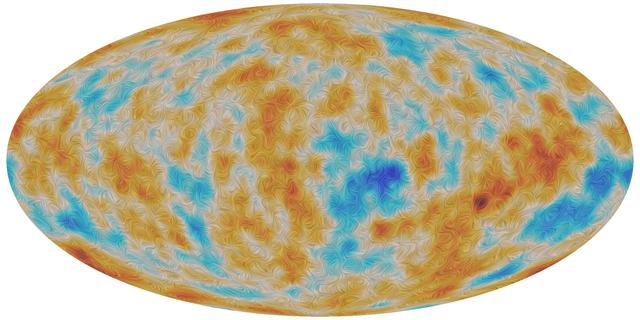 |
| Image Credit: NASA. CMB (Cosmic Microwave Background). |
How Does It Links to Galaxy Formation?
Without dark matter, galaxies would not have formed the way they did. Its gravity was essential in pulling together gas and dust in the early universe.Composition:
We don't know what dark matter is made of but there are theories which try to explain its composition:WIMPS (Weakly Interacting Massive Particles):
This theory suggests that WIMPS are hypothetical particles that barely interact with normal matter.
Axions:
These are ultra-light particles predicted by Quantum Theory.
Sterile Neutrinos:
A theoretical type of neutrino that do not interact with anything except gravity.
Primordial Black Holes:
Tiny blackholes were formed after the Big Bang, which is possible that dark matter is made of it.
None of these have been confirmed, but experiments are ongoing around the world to detect dark matter's composition.
We are made of stardust, but the stars themselves are held by something much more mysterious. Until we understand dark matter, we’re missing a major chapter of the universe’s story.
None of these have been confirmed, but experiments are ongoing around the world to detect dark matter's composition.
How Are Scientists Trying to Find It?
There are several ways by which scientists are trying to find its particles:Direct Detection:
Ultra-sensitive underground labs (like XENON, LUX-ZEPLIN, and DAMA) are trying to catch dark matter particles bumping into atoms.Indirect Detection:
Telescopes like FERMI and AMS-02 are scanning for gamma rays or cosmic rays that could be released when dark matter particles collide and annihilate.Particle Colliders:
The Large Hadron Collider (LHC) tries to create dark matter particles during high-energy collisions.Importance:
Dark matter is important in the following ways:- It holds galaxies together.
- It shapes the Universe's structure.
- It affects the way light travels.
- Without dark matter, our current physics models wouldn’t make sense.
- Understanding dark matter could unlock new physics beyond what we know, possibly even revealing new dimensions or forces.
Conclusion:
Dark matter is the cosmic glue that binds the universe together. Even though we can't see it, it’s everywhere, in and around galaxies, shaping their evolution, and pulling the strings behind the cosmic curtain.We are made of stardust, but the stars themselves are held by something much more mysterious. Until we understand dark matter, we’re missing a major chapter of the universe’s story.


Comments
Post a Comment