What is Mercury: The Smallest Planet in Our Solar System:
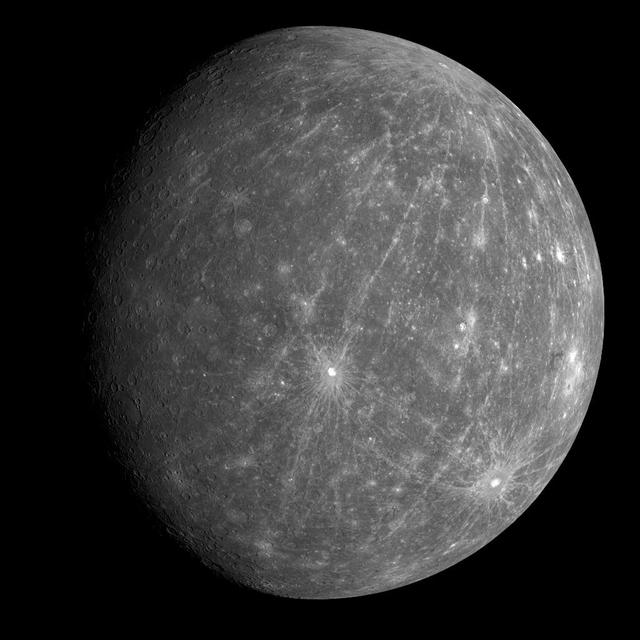 |
Image Credit: NASA. Planet Mercury.
|
Did you know about Mercury? And why is it a unique planet in our Solar System? Mercury is a terrestrial and the first planet of our Solar System. It was named after the Roman god Mercury due to its fast motion. Its surface consists of craters, hills and cliffs. It is grey and rocky just like the Moon.
What Is Its Orbital and Rotational Information?
It completes its orbit around the Sun the fastest in 88 Earth days (1 Mercury year). It has extreme temperatures at day and night due to no atmosphere. It is still a mysterious planet and is not studied deeply. It is present at a distance of 57.9 million km away from the Sun. Its diameter is 4,879 km. It completes its rotation in 59 Earth days.
What Is Its Composition That Makes It Very Dense?
It has a very thin exosphere mostly consisting of sodium, oxygen and hydrogen. Its core is a thick iron core which is partly molten makes up 85% of the planet. It has a very weak magnetic field. It also has the most notable features in the Solar System like Caloris Basin one of the largest impact craters in the Solar System and Scarps which are giant cliffs formed as Mercury's core which are cooled and contracted. There are no active volcanoes or tectonic plates but there are signs of ancient volcanic eruptions. It has no real seasons due to a little 0.03 degrees tilt. It's one day's length is 176 Earth days. It's the second-densest planet in our Solar System after Earth due to rich metal core.
Can We See It?
Yes, it can be seen with naked eye before sunrise or after sunset.
Exploration:
 |
Image Credit: NASA. View of Mercury Taken by Mariner 10.
|
In 1974-75 the Mariner 10 (NASA) was the first flyby which mapped 45% of the surface and discovered its weak magnetic field. The Messenger (NASA) in 2004-15, orbited Mercury, mapped the whole surface, analyzed composition, magnetosphere and found water ice in shadowed craters. Bepi Colombo is a current exploration program launched in 2018 and will end in 2026-27 which took flybys of Earth and Mercury.Discovery And Historical Observations:
How Was It Known to Humans in Ancient Times?
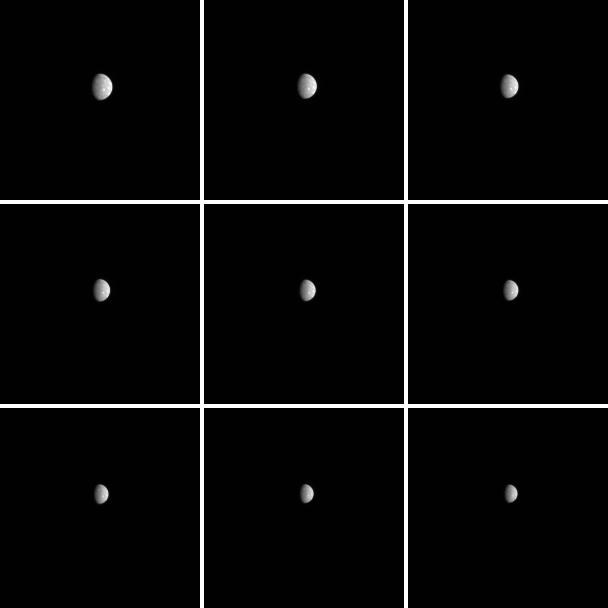 |
Image Credit: NASA. Phases of Mercury.
|
Mercury was known to the humanity from the pre-historic era (early 3,000 BC) because it is a visible planet to the naked eye. The Babylonians called it Nabu, the god of writing and wisdom. The Greeks thought they were two stars, one visible before the sunrise and the second after sunset. They named them as Apollo (morning) and Hermes (evening). Later, a Greek philosopher Pythagoras (6th century BC) corrected them as a single object. The Romans called Facts:
- Mercury was the first object which proved Einstein's theory ''General Relativity'' true.
- You will never see Mercury in a full phase because it has its phases like Moon and Venus.
 |
| Image Credit: NASA. Mercury's Sodium Tail. |
- It is the smallest planet in our Solar System.
- 1 day on Mercury is equal to 176 Earth days.
- It is the second densest planet in the Solar System after Earth.
- Mercury has a tail! Yes, it leaves behind a thin sodium tail due to solar radiation pressure.
- One day on Mercury is 2 times longer than it's one year.
- Because of Mercury's weird rotation and orbit speed, if you stood on Mercury, you would see the Sun rewind.
- Mercury is losing its exosphere daily due to solar wind.
- Because there is no atmosphere so there is no distribution of heat, that's why if you stood on Mercury and your front faced the day side, so your front side will be boiling and your back side faced to the shadow will be freezing at the same time.
- It's the closest planet to the Earth most of the time.
- There is no sound on Mercury due to no atmosphere which means no atmosphere so no sound.
- There is no air resistance, which means if you fly a paper plane, so it would continuously fly forever.
- It's the fastest planet in the Solar System.
- Mercury might have Mercquakes because the planet is still shrinking.
- It reflects less light than asphalt and it's too dark to reflect light.
- It has the tallest scarps in the Solar System.
- Mercury receives 7 times more solar radiations than Earth which means its always sun burned.
- Mercury might be an exoplanet next-door due to its weird composition and characteristics.
- It's the most extreme planet in the Solar System.
Mercury is a planet which is unique in its own way. It is not just a planet but something with unique anomalies.


Comments
Post a Comment